AI Recruitment: Why Companies Still Struggle to Hire
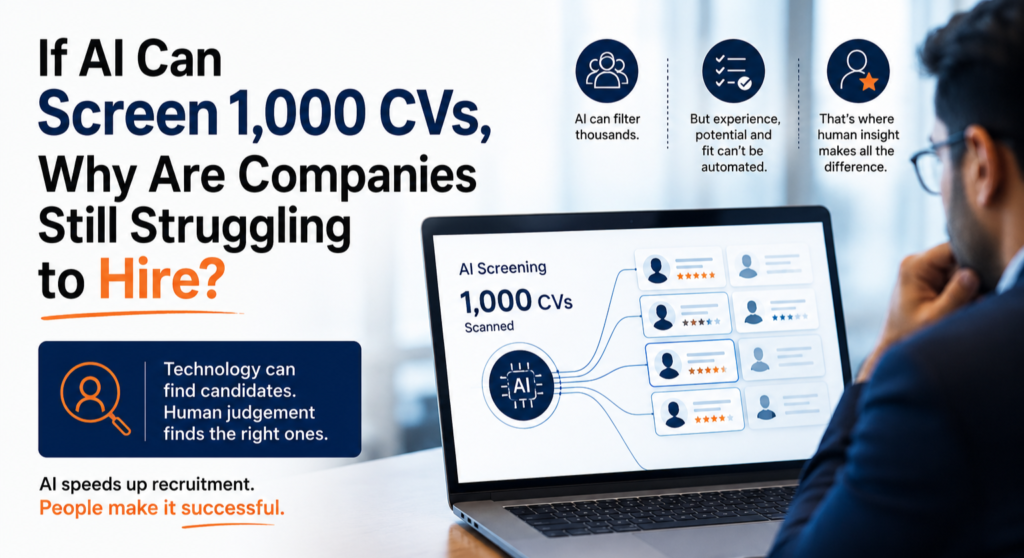
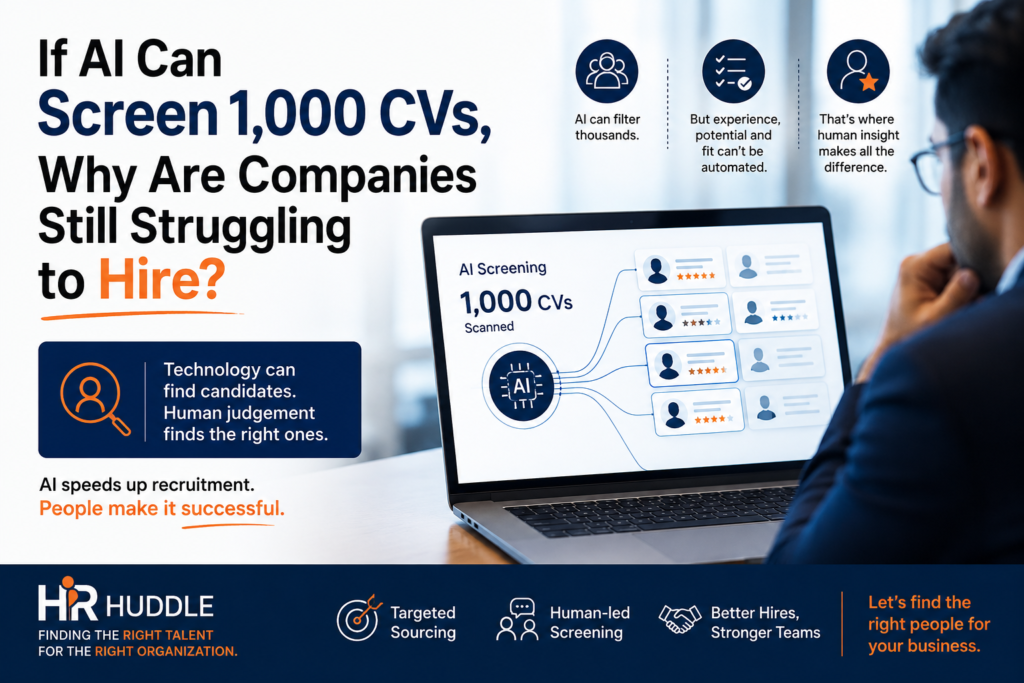
If AI Can Screen 1,000 CVs, Why Are Companies Still Struggling to Hire?
AI can screen 1,000 CVs in the time it takes a recruiter to review a fraction of them. Recruitment technology can match candidates, automate sourcing, schedule interviews and shortlist profiles based on skills, experience and location. So why are companies still struggling to find the right people?
Recruitment has never had more technology, yet critical positions continue to remain open for weeks or even months. Hiring managers are frustrated, good candidates are moving on to other opportunities, and businesses are still asking the same question: “Why can’t we find the right person?”
Perhaps the problem isn’t a lack of candidates. Perhaps it is the way businesses are evaluating them.
AI Has Made Recruitment Faster, But Has It Made Hiring Better?
AI is already changing the way companies approach recruitment. According to Deloitte India’s 2026 research, 86% of surveyed organisations say AI or Agentic AI is transforming recruitment, while 72% are using AI for resume screening.
There is no doubt that this can make parts of the hiring process considerably faster. If a company receives 1,000 applications for a single position, an AI recruitment tool can quickly identify candidates who appear to match the job description. This saves recruiters valuable time and makes it easier to manage large volumes of applications.
But once those 1,000 CVs become 100, the difficult question remains: which of those 100 candidates can actually do the job?
That is where recruitment becomes more complicated.
A Good CV Doesn’t Always Mean a Good Hire
Imagine you are hiring a Sales Head and have two candidates in front of you. Both have ten years of experience, have worked in the same industry, have managed teams and appear to have all the skills mentioned in your job description.
On paper, they look almost identical.
However, one candidate has built a sales function from scratch in a fast-growing company, while the other has spent most of their career working within an established organisation with an existing client base and extensive support systems.
If you are a growing business, those two candidates may perform very differently.
A CV can tell you where someone has worked and what responsibilities they have held, but it does not always tell you how they work, what they have actually achieved or whether their experience translates to your business environment.
That context matters when making a hiring decision.
Candidates Are Using AI Too
There is another side to AI in recruitment that businesses cannot ignore. Recruiters are using AI to screen applications, but candidates are using AI to create them.
CVs can now be rewritten specifically for individual job descriptions. Cover letters can be generated in seconds, and candidates can use AI tools to prepare for common interview questions. Applications can also be tailored to include the exact skills and keywords that an employer is looking for.
This creates an interesting situation. AI is helping recruiters identify candidates who appear to match a role, while candidates are using AI to make themselves appear more closely matched to that role.
As a result, simply finding a CV that ticks all the right boxes is becoming less meaningful. The more important question is: Can this person actually deliver what the business needs?
More Applications Don’t Necessarily Mean Better Hiring
One of the most common complaints businesses make is, “We aren’t getting enough good candidates.” However, in many cases, the real problem isn’t the number of applications.
A company might be receiving hundreds of CVs, but the job description could be too restrictive. The compensation may not be aligned with the market. The company may be looking for a very specific combination of skills that is difficult to find. Or the hiring process itself may be taking so long that good candidates accept other offers before a decision is made.
There is also the issue of where businesses are looking. The right candidate may already be employed and may not be actively applying for jobs at all. They could still be open to the right opportunity, but they are unlikely to find your vacancy through a traditional application process.
More CVs do not automatically mean better hiring. Sometimes, businesses need a better approach to finding and evaluating talent.
The Best Candidate May Not Be Looking for You
This is one of the biggest challenges in modern recruitment. Experienced professionals who are performing well in their current roles are often not actively searching for new jobs. They may not be applying to multiple positions or regularly checking job portals, but that does not mean they would never consider moving.
The right opportunity, compensation, career growth or business environment can change that.
This is where targeted candidate sourcing becomes valuable. Instead of waiting for candidates to discover a vacancy, a recruitment agency can proactively identify relevant professionals and approach them about an opportunity.
Sometimes, the right candidate isn’t missing from the market. You simply aren’t reaching them.
Recruitment Still Needs a Human Element
Technology is excellent at processing information, but hiring is more than an information-processing exercise. It is a business decision that requires understanding both the role and the person behind the CV.
A recruiter or hiring manager needs to understand why a candidate is considering a move, what kind of environment they perform well in, what they have actually achieved, what motivates them and whether their expectations align with what the company can offer.
These conversations can reveal things that a CV or automated screening system cannot.
Someone can meet every requirement listed in a job description and still be the wrong hire. At the same time, another candidate may not tick every single box but could have the experience, attitude and ability to succeed in the role.
This is where human judgement remains important.
So, Where Does AI Fit Into Recruitment?
The answer isn’t to avoid AI. Businesses should absolutely use it where it can make recruitment more efficient.
AI can help with CV screening, candidate matching, sourcing, scheduling, recruitment administration and processing large volumes of information. By taking care of repetitive tasks, it can give recruiters and hiring managers more time to focus on the parts of recruitment that require judgement and conversation.
The future of recruitment isn’t necessarily AI versus recruiters. It is more likely to be AI combined with recruitment expertise.
Technology can help identify possibilities. People still need to determine which possibilities are worth pursuing.
The Question Businesses Should Be Asking
Instead of asking, “How can we get more CVs?”, businesses should be asking, “How can we get better candidates in front of us?”
Instead of asking, “How quickly can AI shortlist these applications?”, ask, “What do we need to know about these candidates before we make a hiring decision?”
And instead of saying, “There aren’t enough good candidates,” ask whether you are actually looking in the right places and evaluating candidates for the right reasons.
These questions can fundamentally change the hiring process.
The Future of Hiring Isn’t More CVs. It’s Better Signals.
AI can make recruitment faster, and that is a significant advantage for businesses. But speed alone does not guarantee a better hire.
The real opportunity is to use technology to reduce the repetitive work involved in recruitment while giving people more time to understand candidates, assess their capabilities and make better hiring decisions.
Because ultimately, you are not hiring a CV. You are hiring someone to solve a business problem, lead a team, win a client, build a function or help move the business forward.
The best recruitment process will use technology to find the possibilities and human judgement to find the right person.
Looking for the Right Talent?
At HR Huddle, we combine targeted candidate sourcing with human-led screening to help businesses find relevant talent across IT and Non-IT functions. Our focus isn’t on sending the maximum number of profiles; it is on understanding what your business actually needs and finding people who can deliver it.
If you’re hiring for a critical role or struggling to find the right candidate, let’s talk.