Why Critical Positions Stay Open ? What It Really Costs Your Business?
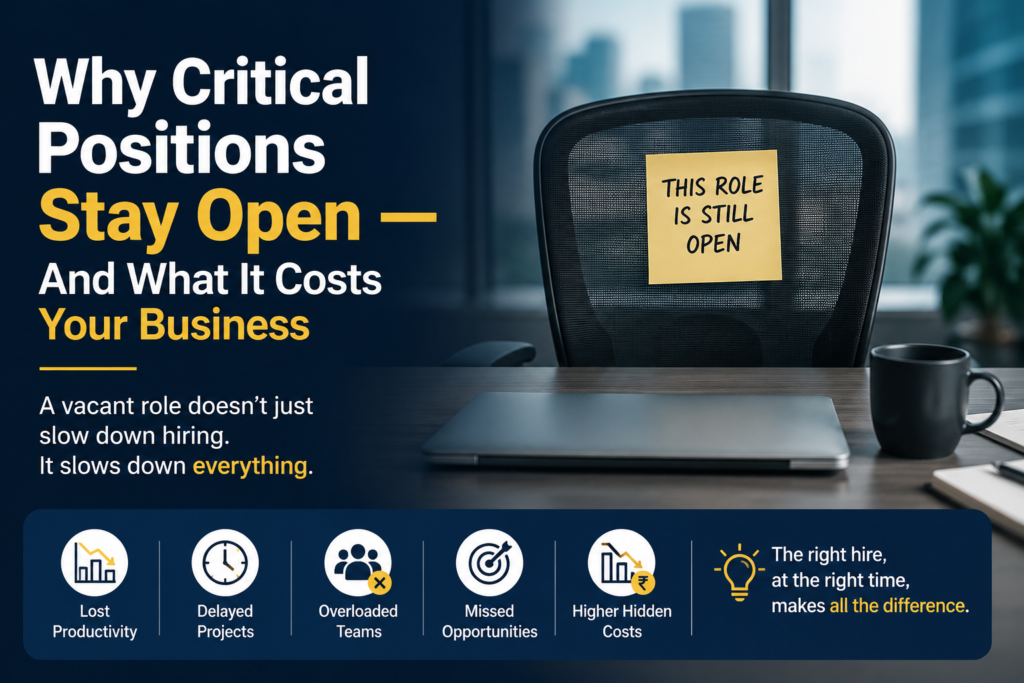
“We’ve been trying to hire for this role for three months.”
You’ve probably heard this before. Maybe you’ve said it yourself.
The position is open.
The team is managing somehow.
The business is still moving.
So it gets pushed down the priority list.
Until you look at what “managing somehow” is actually costing you.
The role is vacant. But the cost isn’t.
Your sales team is covering for a missing leader.
Your existing employees are taking on work that wasn’t theirs.
Your founder is spending time interviewing candidates instead of running the business.
A project is waiting for one person to join.
A client requirement is taking longer to fulfil.
And meanwhile, the vacancy sits in the HR tracker as:
“Open.”
That’s the problem.
We often measure the cost of hiring. We rarely measure the cost of not hiring.
So why are important positions staying open?
Usually, it isn’t because there are no candidates.
It is because somewhere between defining the role and making the offer, the hiring process gets stuck.
“We need someone experienced.”
How experienced?
“We need someone from our industry.”
Does that mean industry experience is essential, or simply preferred?
“The budget is fixed.”
Does the market agree?
“We need the right cultural fit.”
What does that actually mean?
The more unclear the answers, the harder it becomes to find the right person.
And no recruitment agency can fix a requirement that the business itself hasn’t clearly defined.
Then there is the other problem: Waiting.
You finally find a candidate who looks right.
The interview happens.
Everyone likes them.
Then comes: “Let’s take another week to decide.”
By the time the company is ready to make an offer, the candidate has accepted another one.
The frustrating part?
The candidate wasn’t necessarily lost because another company offered significantly more.
Sometimes, they were simply faster.
Good candidates don’t stay available forever.
This is particularly true for experienced professionals.
The people you really want may already have jobs.
They aren’t sitting on job portals waiting for your vacancy.
They may be open to a move. But only if the opportunity, compensation, role and timing make sense.
That’s why recruitment today isn’t just about posting a job and waiting for applications.
It is about finding the right people before someone else does.
And this is where businesses often get stuck.
The internal HR team is capable. The hiring managers know what they need.
But everyone is busy.
HR has ten other priorities. The hiring manager has a business to run.
The position is difficult to fill.
And suddenly, nobody has enough time to actually own the search.
That’s not a talent problem. That’s a capacity problem.
What does an open role really cost?
Let’s take a simple example.
A critical position remains vacant for 90 days. During those 90 days:
- Someone else is doing the work.
- Someone else is covering the responsibilities.
- Someone else is spending time interviewing.
- Something else is being delayed.
- And somewhere, an opportunity is being missed.
Now ask yourself:
Was the vacancy really cheaper than hiring support?
That’s the conversation businesses should be having.
Not:
“How much does a recruitment agency charge?”
But:
“What is this vacancy costing us every month?”
The answer isn’t always “hire an agency.”
- Sometimes your internal team is perfectly equipped to handle the role.
- Sometimes the requirement needs to be redefined.
- Sometimes the compensation needs to be revisited.
- Sometimes the hiring process needs to be faster.
- And sometimes, you simply need more hands on the search.
That’s where a recruitment partner can make a difference.
Not by flooding your inbox with CVs.
But by taking ownership of the search, reaching relevant candidates, screening them and helping your team spend its time where it matters; making the right hiring decision.
Because a vacancy is not just a vacancy.
It can be:
- Lost revenue.
- Lost productivity.
- Delayed growth.
- Burnout for your existing team.
- And leadership time that could have been spent elsewhere.
So the next time someone says,
“We’ve been trying to hire for this role for three months,”
don’t just ask:
“Why haven’t we found the right candidate?”
Ask:
“What has those three months already cost us?”
That may be the more important hiring question.
Is a critical position slowing your business down?
HR Huddle helps businesses source and hire relevant talent across IT and Non-IT functions.
If you’ve been struggling with a critical hire, let’s talk about the problem before it becomes a bigger business cost.