When Should Your Business Hire a Recruitment Agency?
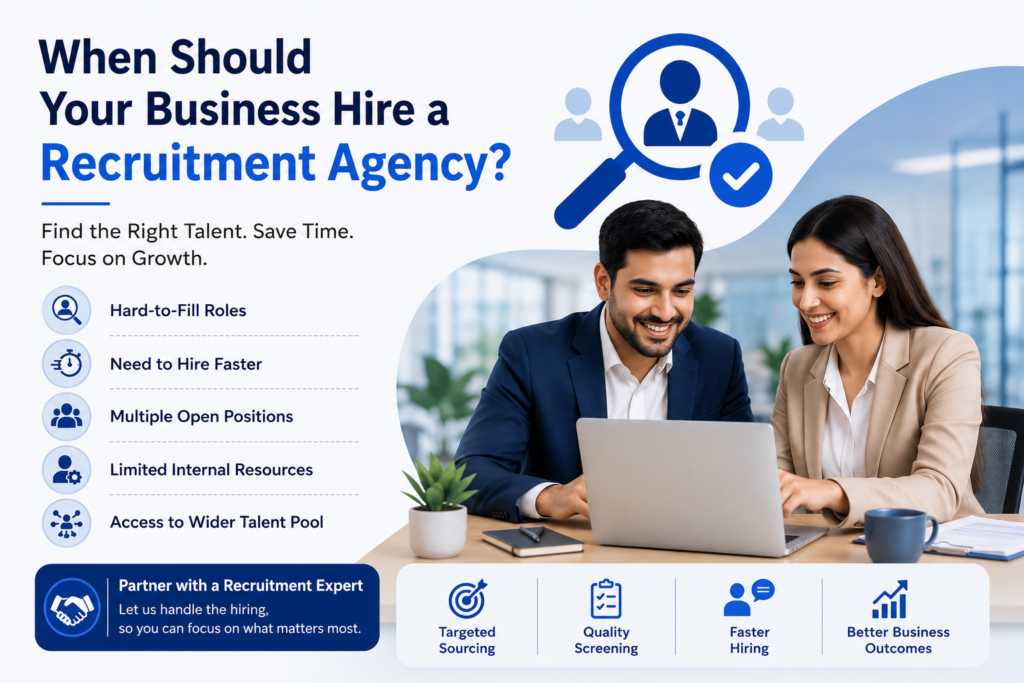
Hiring the right people is one of the most important decisions a business makes. However, as a company grows, recruitment can quickly become time-consuming, difficult and expensive. Here is when the recruitment agency can enter into the scene.
Posting jobs, screening CVs, scheduling interviews and following up with candidates can take significant time. At the same time, your HR team may already be managing employee engagement, HR operations, compliance and other priorities.
This is where a recruitment agency can make a difference.
However, not every company needs external recruitment support for every position. Therefore, the real question is:
When should a company use a recruitment agency?
The answer depends on your hiring volume, the type of roles you need to fill, your internal recruitment capacity and how quickly you need to hire.
What Does a Recruitment Agency Do?
A recruitment agency or recruitment consultancy helps businesses find, screen and connect with suitable candidates for their open positions.
Depending on your requirements, a recruitment partner can support you with:
- Understanding and defining the hiring requirement
- Candidate sourcing
- CV screening
- Initial candidate evaluation
- Interview coordination
- Candidate follow-ups
- Offer coordination
- Recruitment market insights
- Support throughout the hiring process
As a result, your internal HR team does not have to manage every stage of recruitment on its own.
Instead, an experienced recruitment partner can take care of the sourcing and screening process while your team focuses on evaluating and selecting the right candidates.
7 Signs Your Company Should Consider a Recruitment Agency
1. Your Internal HR Team Is Overloaded
First and foremost, look at your internal HR team’s workload. If your HR team is managing recruitment along with HR operations, employee engagement, payroll, compliance and other responsibilities, hiring can quickly become difficult to manage effectively.
As a result, important vacancies may remain open for longer than expected.
In such situations, a recruitment agency can provide additional sourcing and screening support. This allows your internal HR team to focus on other priorities while maintaining momentum on open positions.
2. You Are Struggling to Find the Right Candidates
Receiving CVs is not the same as finding suitable candidates. For example, you may receive hundreds of applications for a position, but only a small percentage may actually meet your requirements.
Moreover, the most suitable candidates may not always be actively applying for jobs. A recruitment consultancy can therefore use targeted sourcing, professional networks, recruitment databases and direct candidate outreach to identify relevant talent.
The objective should not be to receive more CVs. Instead, the objective should be to find more relevant candidates.
3. You Need to Hire Quickly
Sometimes, an open position cannot remain vacant for months. For example, an unfilled sales position can affect revenue, while an operations vacancy can increase the workload on your existing team. Similarly, a critical technology role could delay an important project.
Therefore, when time-to-hire matters, additional recruitment support can help increase your sourcing capacity and keep the hiring process moving. However, hiring quickly should never mean lowering your hiring standards.
The goal should be to hire faster without compromising candidate quality.
4. You Are Hiring for a Difficult-to-Fill Role
Some positions are naturally harder to fill than others. These may include:
- Specialised technology roles
- Senior management positions
- Experienced sales professionals
- Industry-specific specialists
- Finance and accounting professionals
- Marketing and digital professionals
- Hard-to-find operational talent
In these situations, simply posting a job may not be enough. Instead, targeted candidate sourcing becomes increasingly important.
An experienced recruitment agency can help identify candidates who may not be actively looking for a job but could be interested in the right opportunity.
5. You Are Hiring Multiple People at Once
Business growth often brings multiple vacancies at the same time. For example, a growing company may need to hire across sales, technology, finance, operations and marketing within the same period.
Consequently, your internal HR team may struggle to give every vacancy the attention it requires.A recruitment agency can provide additional hiring bandwidth and help manage sourcing across multiple positions.
This can be particularly useful for startups, SMEs and growing businesses that are expanding their teams.
6. You Are Spending Too Much Time Screening CVs
One of the biggest hidden costs of recruitment is the amount of time spent reviewing irrelevant applications. Your HR team may spend hours going through CVs only to discover that many candidates do not meet the basic requirements of the role.
A recruitment partner can help filter candidates based on the agreed requirements before profiles reach your hiring manager. As a result, your team can spend more time interviewing relevant candidates rather than screening hundreds of unsuitable applications.
More CVs do not necessarily mean better hiring.
7. You Want Access to a Wider Talent Pool
Not every suitable candidate is actively searching for a new job. In fact, many experienced professionals are passive candidates who may consider the right opportunity if it is presented to them.
Therefore, relying only on job applications can limit your talent pool. Recruitment agencies can use professional networks, candidate databases, referrals, direct outreach and targeted sourcing to reach a broader range of candidates.
This is particularly valuable when hiring for specialised or experienced positions.
Recruitment Agency vs Hiring Internally: Do You Need to Choose One?
Not necessarily. In fact, many businesses benefit from combining internal HR capabilities with external recruitment support.
Your HR team understands your organisation, culture, internal processes and long-term workforce requirements. On the other hand, a recruitment partner can bring additional:
- Candidate sourcing capacity
- Recruitment market knowledge
- Talent networks
- Screening support
- Industry expertise
- Hiring bandwidth
Therefore, a recruitment agency does not necessarily have to replace your internal HR team. Instead, it can work as an extension of your hiring team.
How to Choose the Right Recruitment Agency
Once you decide to work with a recruitment consultancy, choosing the right partner becomes equally important.
Before partnering with an agency, consider the following:
Does the agency understand your industry?
A good recruitment partner should understand the type of talent you need and the market in which you operate.
Do they understand the role before sourcing?
Recruitment should begin with understanding the requirement. If a recruiter starts sending CVs without understanding the role, there is a greater chance of receiving irrelevant profiles.
How do they screen candidates?
Ask how candidates are evaluated before they reach your hiring team. A strong screening process can save your HR team considerable time.
How do they communicate?
Recruitment involves multiple stakeholders. Therefore, clear and timely communication between the client and recruitment partner is essential.
Do they focus on quality or quantity?
Receiving 100 irrelevant CVs does not solve a hiring problem. Instead, look for a recruitment partner that prioritises relevance, quality and fit.
When Should You Not Use a Recruitment Agency?
A recruitment agency is not necessarily required for every vacancy. For example, if you have a strong internal recruitment team, an established talent pipeline and sufficient time to manage the hiring process, internal recruitment may be the most practical option.
Similarly, for high-volume roles where you already have an efficient sourcing process, additional external support may not always be necessary.
Ultimately, the decision should depend on your company’s specific hiring needs.
What Is the Real Cost of Hiring?
When considering whether to use a recruitment agency, businesses often focus only on the recruitment fee. However, the actual cost of hiring can include much more:
- Time spent screening CVs
- Interview coordination
- Managerial time
- Cost of keeping a position vacant
- Delayed projects
- Lost productivity
- Repeated hiring attempts
- Candidate drop-offs
- Cost of a wrong hire
Therefore, the real question should not simply be:
“What does a recruitment agency cost?”
Instead, ask:
“What is the cost of leaving this position open or hiring the wrong person?”
This broader perspective can help businesses make better recruitment decisions.
How HR Huddle Can Help
At HR Huddle, we work with businesses across IT and Non-IT recruitment requirements. We start by understanding the role, business requirement and candidate profile. Then, we use targeted sourcing and candidate screening to identify relevant talent.
Most importantly, our focus is not on sending the maximum number of CVs.
Our focus is on finding the right talent for the right organisation.
Whether you are hiring for a critical position, expanding your team or simply need additional recruitment support, the right hiring partner can make the process more efficient.
Looking to Hire?
If your company has an open position or upcoming hiring requirement, talk to HR Huddle. Share your requirementwith us and let us help you find the right talent for your business.